Mobile Application / Enterprise Utility
PNRE Mobile
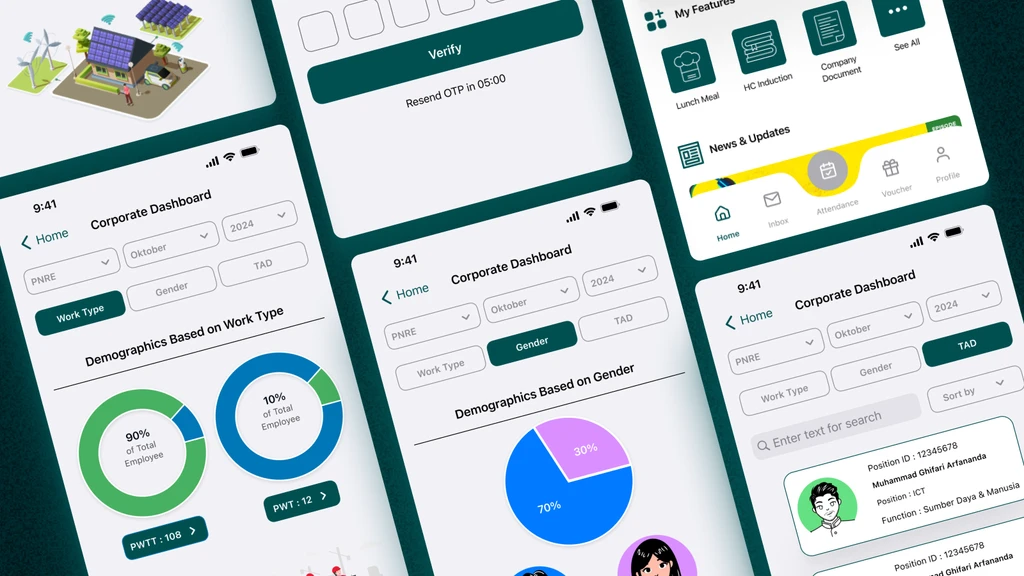
A centralized mobile experience for PNRE employees to access attendance, lunch vouchers, HC Induction, document submission, and internal company information.
Design Intent and Evidence Status
The design was intended to make frequent employee services easier to access and understand, especially attendance and lunch-related tasks. Verified post-launch metrics, participant counts, usability results, and implementation status were not available in the source material, so this case study does not claim measured conversion, adoption, or productivity gains.
Project Snapshot
PNRE Mobile is a mobile application designed to support PNRE employees' daily operational needs. The product brings attendance, lunch voucher access, HC Induction, document submission, and internal company information into one centralized mobile experience.
Client: Pertamina New & Renewable Energy Role: UI/UX Designer Timeline: July 2023 - February 2024 Platform: Mobile application Status: Project outcome and release status require confirmation.
Context, Problem, and Constraints
When PNRE employees returned to Work From Office activities, the attendance process still depended on a tapping device available only on the 12th floor, while employees worked across the 6th, 9th, and 12th floors. This created unnecessary location dependency for a routine task.
The product also needed to support lunch distribution through voucher scanning, online HC Induction, document submission through the company dashboard, and employee information through a corporate dashboard. The solution therefore had to centralize several services without making the mobile experience difficult to navigate.
Goals and Success Criteria
The design goals were to:
- Make clock-in and clock-out available through employees' smartphones.
- Connect attendance with a clear lunch voucher flow.
- Support HC Induction online.
- Provide access to document submission and internal information.
- Create a scalable structure for PNRE and potential PGE-related needs.
No formal quantitative success criteria were documented in the available project material. Future validation should measure task completion, time on task, error recovery, and adoption of priority services.
Role, Contribution, and Collaboration
I worked as a UI/UX Designer during my internship at PNRE. My contribution was designing the mobile interface and translating operational requirements into user flows, information architecture, wireframes, and final interface designs.
The available project material does not document the exact team composition or a formal ownership matrix. These details should be confirmed before publishing claims about research ownership, usability testing, development, or handoff.
Research Questions and Methods
The project required understanding how employees accessed attendance and related workplace services across different locations. Key questions included:
- How did employees currently record attendance across floors?
- What friction came from the tapping device being located on the 12th floor?
- How was lunch access connected to attendance?
- Which services needed to be immediately accessible on mobile?
- Which operational requirements could not be changed?
The source material confirms that existing workflows and operational needs informed the design, but does not provide a verified participant count, recruitment profile, research method, or session detail.
Evidence and Key Findings
The strongest confirmed evidence was the mismatch between infrastructure and employee distribution: the tapping device was on the 12th floor, while employees worked across the 6th, 9th, and 12th floors.
This indicates that attendance access was location-dependent. It also shows why attendance and lunch access needed to be considered as connected tasks rather than isolated features.
Additional raw evidence, user quotes, affinity mapping, analytics, and usability findings should be added when project records are available.
Reframed Problem
The initial opportunity could be understood as replacing a physical attendance device with a mobile interface. A broader framing is more useful: PNRE needed a centralized mobile workplace hub that reduced location dependency while keeping attendance, lunch, onboarding, document, and information services understandable and scalable.
Insight-to-Decision Mapping
Evidence: The attendance device was available only on the 12th floor. Decision: Make attendance a prominent mobile entry point rather than a location-specific action.
Evidence: Lunch access was connected to employee attendance. Decision: Treat attendance status and lunch voucher access as related steps in the experience.
Evidence: The product needed to support multiple internal services. Decision: Use a centralized information architecture and reusable interface patterns so new services can be added without changing the interaction model.
Before-and-After Information Architecture and Flow
Before: Employees depended on a physical tapping point on the 12th floor for attendance, while other workplace services were handled through separate processes.
After: Employees could access attendance, lunch voucher scanning, HC Induction, document submission, and internal information from one mobile application.
The proposed structure prioritized daily attendance and connected lunch actions while keeping supporting services discoverable. Exact before-and-after step counts should be added from the original workflow documentation.
Design Alternatives and Trade-offs
The design needed to balance immediate access to frequent tasks with the need to support several internal services. The selected direction used a centralized mobile structure with task-focused entry points and consistent interface patterns.
The available source material does not preserve the rejected design alternatives or the specific trade-offs considered. Wireframes or version history should be added here to show alternatives that were actually explored and why they were rejected.
Final Solution
The final concept brought several employee services into one mobile experience:
- Mobile attendance for clock-in and clock-out.
- Lunch voucher access and scanning after attendance.
- Online HC Induction for new employees.
- Company Dashboard for document submission and access.
- Corporate Dashboard for employee information.
The interface used a centralized structure, clear task-based flows, consistent components, and a modular foundation intended to support future services.
Validation and Iteration
Design decisions were refined around operational requirements, user flow clarity, interface consistency, and scalability. However, the available project material does not verify a formal usability study, participant count, task script, success rate, or retest result.
To strengthen this case study, add the testing setup, observed issues, design changes, and evidence from each iteration. Do not describe stakeholder review as usability testing unless representative users participated.
Outcome and Impact
The project produced a centralized mobile experience concept for PNRE employee services and established a clearer structure for attendance, lunch access, onboarding, document submission, and internal information.
The design was intended to reduce dependence on limited physical attendance infrastructure and improve discoverability of workplace services. No verified post-launch metrics were available, so business impact, adoption, and productivity improvements are not claimed.
Reflection and Next Steps
This project reinforced that centralizing services is not enough; the relationship between tasks, status feedback, and operational rules must remain clear. Attendance and lunch flows require special attention because users need confidence that an action has been recorded and that the next step is available.
Next steps would include usability testing with employees from different floors and roles, validation of location and identity requirements, testing under poor connectivity, and measurement of task completion, errors, and adoption after implementation.